
How to Load a Trailer Safely: Weight & Balance
Loading a trailer wrong is one of the most common causes of highway accidents. A load that is too heavy in the back causes trailer sway that can flip both the trailer and the tow vehicle. Too much weight on the tongue...
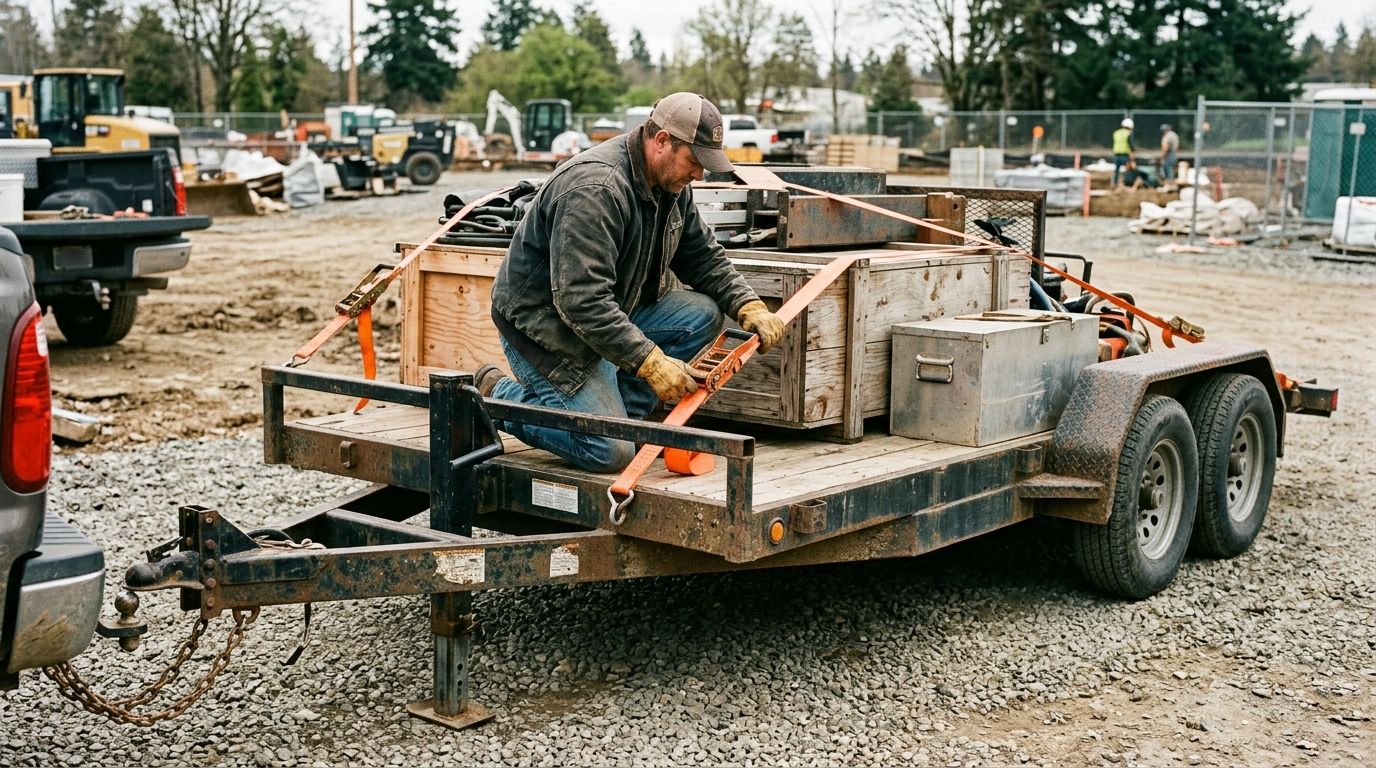
Load a trailer safely by following the 60/40 rule: 60% of cargo weight in front of the axle, 40% behind it. Target tongue weight of 10-15% of the loaded trailer weight for bumper-pull rigs. Keep the load low and centered, use ratchet straps rated to your load weight, and check the hitch, safety chains, lights, and tire pressure before every haul.
Loading a trailer wrong is one of the most common causes of highway accidents. A load that is too heavy in the back causes trailer sway that can flip both the trailer and the tow vehicle. Too much weight on the tongue overpowers your truck's steering. Either way, people get hurt. The good news is that loading a trailer safely comes down to a handful of physics rules and a five-minute routine before you pull out of the driveway. This guide covers all of it.
The 60/40 Rule: How to Distribute Weight on a Trailer
The single most important rule for bumper-pull and utility trailers is the 60/40 rule: place roughly 60% of your cargo weight in front of the axle and 40% behind it. This puts a positive downward force on the hitch ball — called tongue weight — that keeps the trailer tracking straight under your tow vehicle.
Why does it matter? When too much weight rides behind the axle, the tail of the trailer gets heavy and the tongue gets light. The trailer then wants to pivot around the axle. At highway speed that starts as a slow sway, and it can escalate into a full fishtail within seconds. Drivers who have never experienced trailer sway often overcorrect with the steering wheel, which makes it worse.
For a standard bumper-pull trailer, target a tongue weight of 10-15% of the loaded trailer's gross weight. If your loaded trailer weighs 5,000 lbs, you want 500-750 lbs of tongue weight pressing down on the hitch ball. Gooseneck and fifth-wheel trailers carry more of the load over the tow vehicle's rear axle and target a higher range, typically 15-25% of trailer gross weight.
Practical tips for getting the 60/40 balance right:
- Load the heaviest items first, centered over or just ahead of the axle.
- Spread weight evenly side-to-side — a left-heavy or right-heavy trailer creates a lean that stresses tires and suspension.
- Stack lower. Keeping the center of gravity close to the trailer deck reduces the rocking moment in turns and crosswinds.
- Use a tongue-weight scale or a bathroom scale under the coupler (with the trailer level and unhitched from the truck) to verify.
Securing the Load: Straps, Chains, and the Rules That Matter
Unsecured cargo is a federal highway violation and a lethal hazard. The Federal Motor Carrier Safety Administration (FMCSA) cargo-securement rules apply to commercial drivers, but the physics applies to everyone: a 40 mph stop can launch an unsecured 200 lb box with thousands of pounds of force. Use proper tie-downs and use enough of them.
Key securement rules for anyone loading a trailer:
- Working Load Limit (WLL), not break strength. Every strap, chain, and binder is rated by WLL — the maximum load it is designed to restrain in normal use. Use straps rated for the job, and do the math: if your load weighs 4,000 lbs, you need tie-downs whose combined WLL meets or exceeds 4,000 lbs.
- Two straps minimum for any vehicle or piece of equipment. For vehicles (cars, ATVs, skid steers), run at least four tie-down points — one at each corner. Never rely on a single strap across the middle.
- Ratchet straps for most loads. Ratchet straps let you cinch down tight and hold tension. Cam buckle straps are fine for lighter, non-shifting cargo but do not use them on anything that can roll or slide.
- Chains and binders for heavy equipment. Transport chains (Grade 70 or Grade 80) and lever or ratchet binders are the right tool for heavy machinery, large equipment, and any load over the WLL of available straps. Check the chain grade stamp before you assume it is rated for the job.
- Use the trailer's d-rings and tie-down rails. Do not loop straps around frame members not designed as tie-down points. Manufacturers install d-rings and stake pockets for a reason.
- Re-check after the first 50 miles. Vibration and settling can loosen straps. Pull over and re-tension before continuing on a long haul.
Need a trailer with built-in d-rings and tie-down rails? Browse available trailers on BigLoads and filter by type to find flatbed, equipment, and utility trailers near you that are set up for serious loads.
Know Your Weight Limits: GVWR, Axle Ratings, and Hitch Class
Three ratings govern how much you can legally and safely tow. Exceeding any one of them is a problem.
- GVWR (Gross Vehicle Weight Rating). This is the maximum loaded weight of the trailer — the trailer itself plus everything on it. It is stamped on the trailer's VIN plate. Never exceed it.
- Axle rating. Each axle has its own maximum. A tandem-axle trailer with two 3,500 lb axles has a combined axle rating of 7,000 lbs, which typically matches the GVWR. Overloading axles blows tires and bends spindles.
- Tow vehicle rating and hitch class. Your truck or SUV has a maximum tow rating from the manufacturer. Your hitch has a class rating (Class III handles up to 8,000 lbs GTW on most setups; Class V goes to 18,000+ lbs). Both must exceed the loaded trailer weight. When in doubt, look it up in the owner's manual or door placard.
Towing laws vary by state and can affect what you are required to carry (chains, brakes, breakaway systems) based on trailer weight. Before you haul through an unfamiliar state, check out our trailer towing laws guide and related state guides on BigLoads for the specific rules where you are heading.
If you are renting a trailer and want to make sure you are looking at equipment that fits your truck, you can also check out dump trailer rental sizes and ratings for a hands-on comparison of common trailer weight classes.
Pre-Trip Checklist: Do This Before Every Load
Five minutes before you leave saves hours on the side of the road — or worse. Run this checklist every single time:
- Hitch and coupler latched. The coupler should be fully seated on the ball with the latch locked and the keeper pin or clip in place. Give it a physical lift — if it comes up, it is not latched.
- Safety chains crossed and connected. Cross the chains under the tongue in an X pattern so they cradle the tongue if it comes off the ball. Leave just enough slack for turns.
- Trailer brakes (if equipped) working. Plug in the brake controller connection, pull forward slowly, and test that the trailer brakes respond.
- Breakaway cable clipped to the tow vehicle. Required on most states' trailers over 1,500-3,000 lbs. It triggers the trailer brakes if separation occurs.
- All lights working. Running lights, brake lights, and turn signals. Walk around the trailer with a helper or use a reflective surface.
- Tire pressure checked. Trailer tires are often run under-inflated. Check the sidewall max and the trailer manufacturer's recommended pressure. Low trailer tires overheat under load and blow out.
- Load balanced and secured. Give every strap a final tug. Make sure nothing is dragging, sticking out the sides, or shifting freely.
- Mirrors adjusted. Extended tow mirrors are not optional on wide loads. If you can't see down both sides of the trailer, you have a blind spot problem.
Common Loading Mistakes and How to Avoid Them
Even experienced haulers make these errors:
- Loading all the weight in the back. This is the number one cause of trailer sway. Heavy items go in front of the axle, always.
- Stacking too high. A high center of gravity makes the trailer roll-prone in crosswinds and sharp turns. Keep the load as low and compact as possible.
- Using one strap for everything. Straps loosen and sometimes break. Redundancy is not optional — use at least two independently anchored tie-downs per load section.
- Forgetting to recheck. Vibration loosens ratchet straps, especially on rough roads. Re-tension after the first 50 miles and at every fuel stop on long hauls.
- Ignoring the tow vehicle's payload rating. Tongue weight counts against your truck's payload (not just its tow rating). Add up the driver, passengers, gear in the bed, and tongue weight — if you exceed the payload rating, your rear suspension is overloaded even if the hitch rating is fine.
Loading a trailer safely is not complicated, but it does require a few minutes of intention before every trip. Get the 60/40 weight distribution right, use proper tie-downs with adequate WLL, verify your ratings, and run the pre-trip checklist every time. Ready to find the right trailer for your job? Search available trailers near you on BigLoads and rent directly from a local owner.
Frequently Asked Questions
What is the 60/40 rule for loading a trailer?
What should tongue weight be for a bumper-pull trailer?
How many ratchet straps do I need to secure a load?
What is GVWR and why does it matter for trailer loading?
What should I check before driving with a loaded trailer?
Ready to haul?
Find the right trailer near you — or list yours and start earning.